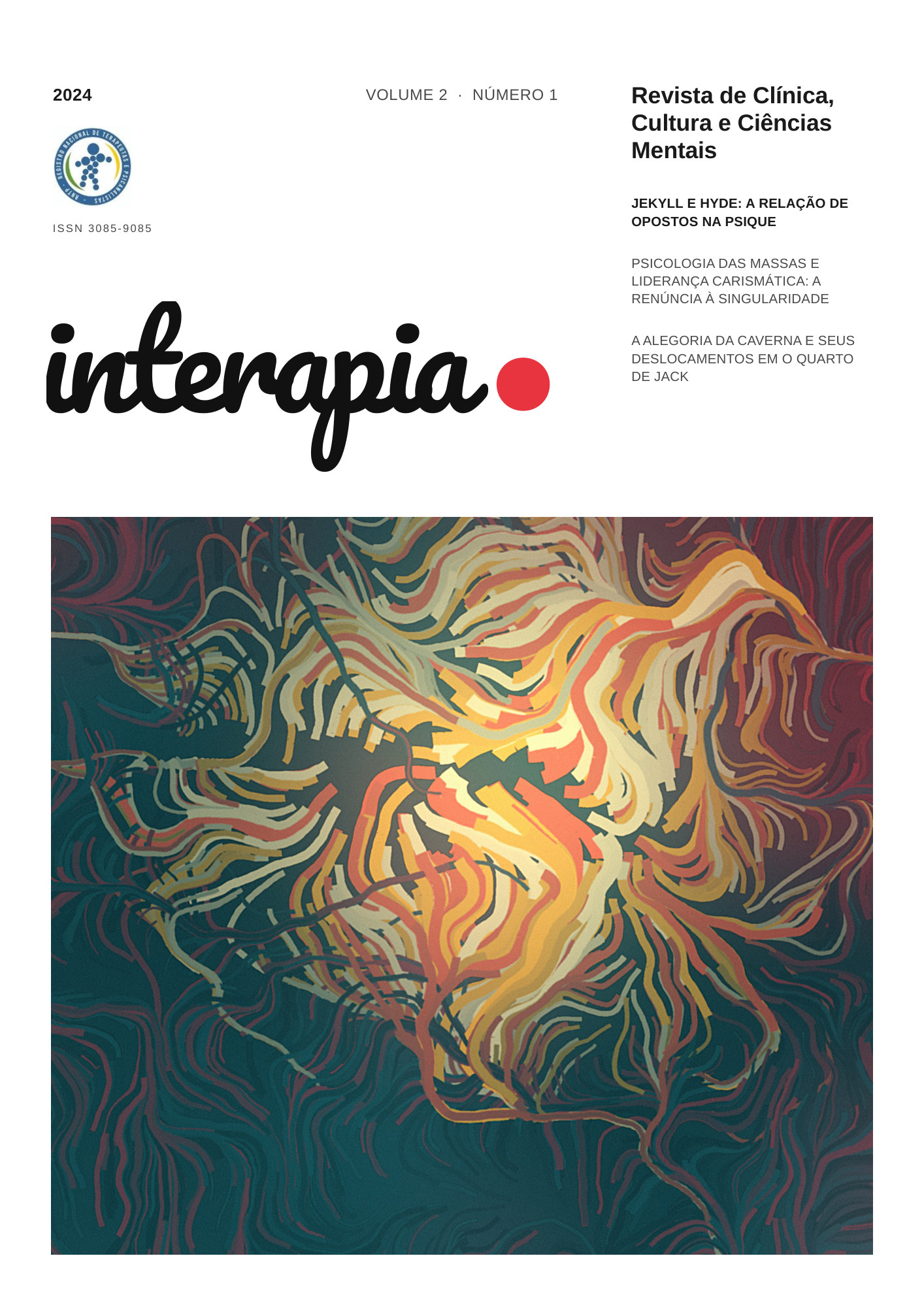
The allegory of the cave and its displacements in Room: image, maternal function and accession to the reality principle
Keywords:
allegory of the cave, Plato, psychoanalysis and cinema, constitution of the self, reality principleAbstract
This essay examines how the allegory of the cave, set out by Plato in book VII of The Republic, operates as a reading key for the film Room (2015), directed by Lenny Abrahamson from Emma Donoghue's novel of the same name. It argues that the correspondence between the two works is not exhausted by the situational resemblance between captivity and the underground prison, and that its theoretical interest lies precisely where the analogy shifts. Three such displacements are identified and developed: the inversion of the status of the image, since in the film it is the televisual simulacrum that receives the index of unreality while the place of captivity is affirmed as world; the presence, absent in Plato, of a maternal function that is at once captive and institutor of the world the child inhabits; and the conversion of the exit into a psychic passage, legible in Freudian terms as the accession to the reality principle and as mourning. It concludes that the allegory remains operative as a theory of the reorientation of the gaze, yet requires psychoanalytic concepts concerning the constitution of the self in dependence on the other.
References
AUMONT, J.; MARIE, M. A análise do filme. 2. ed. Lisboa: Edições Texto & Grafia, 2009.
BION, W. R. O aprender com a experiência. Rio de Janeiro: Imago, 1991.
DONOGHUE, E. Room. London: Picador, 2010.
FERENCZI, S. Confusão de língua entre os adultos e a criança (1933). In: Obras completas: psicanálise IV. São Paulo: Martins Fontes, 1992. p. 97-106.
FREUD, S. Formulações sobre os dois princípios do funcionamento mental (1911). In: Edição standard brasileira das obras psicológicas completas de Sigmund Freud, v. 12. Rio de Janeiro: Imago, 1996a. p. 237-244.
FREUD, S. Luto e melancolia (1917). In: Edição standard brasileira das obras psicológicas completas de Sigmund Freud, v. 14. Rio de Janeiro: Imago, 1996b. p. 275-291.
FREUD, S. A negativa (1925). In: Edição standard brasileira das obras psicológicas completas de Sigmund Freud, v. 19. Rio de Janeiro: Imago, 1996c. p. 263-269.
FREUD, S. Inibições, sintomas e ansiedade (1926). In: Edição standard brasileira das obras psicológicas completas de Sigmund Freud, v. 20. Rio de Janeiro: Imago, 1996d. p. 95-201.
KLEIN, M. Notas sobre alguns mecanismos esquizoides (1946). In: Inveja e gratidão e outros trabalhos. Rio de Janeiro: Imago, 1991. p. 17-43.
LACAN, J. O estádio do espelho como formador da função do eu (1949). In: Escritos. Rio de Janeiro: Jorge Zahar, 1998. p. 96-103.
LACAN, J. O Seminário, livro 11: os quatro conceitos fundamentais da psicanálise (1964). Rio de Janeiro: Jorge Zahar, 1988.
LAPLANCHE, J.; PONTALIS, J.-B. Vocabulário da psicanálise. 4. ed. São Paulo: Martins Fontes, 2001.
METZ, C. O significante imaginário: psicanálise e cinema. Lisboa: Livros Horizonte, 1980. O QUARTO de Jack (Room). Direção: Lenny Abrahamson. Roteiro: Emma Donoghue. Produção: Element Pictures; No Trace Camping. Irlanda; Canadá: A24; Universal, 2015. 1 filme (118 min), son., color.
PLATÃO. A República. Tradução de Maria Helena da Rocha Pereira. 9. ed. Lisboa: Fundação Calouste Gulbenkian, 2001.
WINNICOTT, D. W. O brincar e a realidade. Rio de Janeiro: Imago, 1975.
WINNICOTT, D. W. O ambiente e os processos de maturação: estudos sobre a teoria do desenvolvimento emocional. Porto Alegre: Artes Médicas, 1983.
Downloads
Published
Issue
Section
Categories
License
Copyright (c) 2024 Leonardo Rodrigues

This work is licensed under a Creative Commons Attribution-NonCommercial 4.0 International License.
License Terms
All articles published in Interapia – Journal of Clinic, Culture, and Mental Sciences are licensed under the:
Creative Commons Attribution-NonCommercial 4.0 International License (CC BY-NC 4.0)
This means that authors retain copyright of their works and grant the journal the exclusive right of first publication, allowing third parties to share, distribute, and reuse the content provided that:
-
Proper authorship attribution is given, clearly citing the journal and the authors;
-
The use is strictly non-commercial;
-
Any adaptations or transformations also acknowledge the original source.
Commercial use of any content is strictly prohibited without prior written permission from the authors and the editorial board.
Recommended citation:
LAST NAME, First Name. Article title. Interapia – Journal of Clinic, Culture, and Mental Sciences, v. X, n. Y, pp. XX–XX, month/year.
Available at: [link to article].
Licensed under CC BY-NC 4.0.